
_edited.png)

REFINED LEGS. RESTORED CONFIDENCE.
Sclerotherapy is a minimally invasive treatment designed to reduce the appearance of spider veins and small varicose veins using a targeted medical solution that supports vein closure and natural reabsorption.
Restore smoother-looking skin with clinically established vein treatment and minimal downtime.
What is
Sclerotherapy?
Sclerotherapy is a medical aesthetic vein treatment used to address:
- Spider veins
- Small varicose veins
- Visual superficial veins
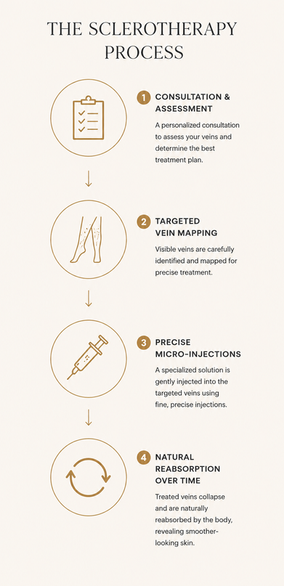
A specialized solution is carefully injected into the targeted vein, causing the vessel walls to collapse and gradually be reabsorbed by the body over time.
Sclerotherapy has been used for decades and is considered one of the most established treatments for cosmetic superficial veins.


Common Concerns Treated
Spider veins
Small varicose veins
Leg discoloration from visible vessels
Cosmetic vein visibility
Reticular veins
Mild vein-related skin irregularities


OUR TREATMENTS
How Sclerotherapy Works
The injected solution irritates the inner lining of the targeted vein, causing it to collapse and gradually fade as the body naturally absorbs the treated vessel. Blood flow is naturally redirected towards healthier surrounding veins.
VEIN CLOSURE
Supports targeted
vessel collapse
REABSORBTION
Body gradually absorbs
treated vein
CIRCULATION
REDIRECTED
Blood reroutes through healthier veins
COSMETIC
IMPROVEMENT
Visible veins
progressively fade
CONFIDENCE
RESTORATION
Supports
smoother-looking
skin appearance
Clinically Established Results


THE RESULTS
Visible. Noticeable. Lasting.


Results shown are for visual inspiration only and may not reflect individual treatment outcomes. Every patient’s skin, hair, biology, and response to treatment are unique. Results vary based on factors including age, condition severity, treatment plan, lifestyle, and consistency of care.
Investment
SCHLEROTHERAPY TREATMENTS
Small Area / Single Session
Approximately $150–350
Larger Area / Extended Treatment
Approximately $300–600
Treatment recommendations and pricing vary depending on the size and number of veins being treated.

Treatment Protocol

What to Expect

Optimizing Results


The Science Behind Sclerotherapy
What Is Sclerotherapy?
Sclerotherapy is a minimally invasive medical treatment used to reduce the appearance of spider veins, reticular veins, and small varicose veins. During treatment, a specialized solution called a sclerosant is injected directly into the targeted vein. This solution irritates the inner lining of the vessel, causing the vein to close. Over time, the treated vein is naturally absorbed by the body and blood flow is redirected through healthier surrounding veins.
Sclerotherapy has been used for decades and remains one of the most established treatments for superficial leg veins, especially spider veins and smaller visible veins.
How Sclerotherapy Works
The goal of sclerotherapy is to close unwanted superficial veins so they gradually fade from view. The injected sclerosant creates a controlled reaction inside the vein wall, causing the vessel to collapse and seal. Once closed, the body gradually breaks down and reabsorbs the treated vein.
Because these treated veins are superficial, circulation naturally redirects through deeper, healthier veins. This is why sclerotherapy can improve cosmetic vein visibility without compromising healthy circulation when performed appropriately.
What Sclerotherapy Treats
Sclerotherapy may be used to treat:
-
Spider veins
-
Small varicose veins
-
Reticular veins
-
Visible superficial leg veins
-
Cosmetic vein concerns
-
Mild vein-related discoloration
Spider veins and reticular veins are commonly treated with injected sclerosants, and medical sources describe sclerotherapy as a first-line treatment for spider veins on the legs.
Expected Results Timeline
Results are gradual. Small spider veins may begin to fade within 3 to 6 weeks, while larger veins may take 3 to 4 months to show improvement. Some patients require more than one session depending on the number, size, and severity of the veins being treated.
This is why sclerotherapy is best understood as a progressive treatment rather than an instant cosmetic correction.
Why Multiple Sessions May Be Needed
The number of sessions depends on:
-
The size of the veins
-
The number of veins being treated
-
The location of the veins
-
How the veins respond to treatment
-
Whether new veins develop over time
Downtime & Recovery
Sclerotherapy is generally performed in-office and usually involves minimal downtime. Many patients return to normal activities quickly, although walking is often encouraged after treatment to support circulation.
Temporary side effects may include:
-
Mild bruising
-
Tenderness
-
Redness
-
Temporary discoloration
-
Small raised areas near injection sites
-
Minor stinging or sensitivity
These effects are usually temporary and part of the normal healing response.
Compression & Aftercare
Compression garments may be recommended after treatment to support circulation and healing. Compression helps improve blood flow in the lower legs and may reduce pooling or swelling.
Patients may also be advised to:
-
Walk regularly
-
Avoid strenuous lower-body exercise temporarily
-
Avoid prolonged standing immediately after treatment
-
Avoid excess heat exposure
Follow provider-specific aftercare instructions.
Lifestyle Factors That Support Vein Health
& Safety Considerations
Healthy circulation can support long-term results. Movement, exercise, weight management, leg elevation, and avoiding prolonged sitting or standing may help reduce the risk of future vein concerns.
Sclerotherapy is widely used, but it is still a medical procedure and requires proper assessment. A consultation is important to determine whether the visible veins are appropriate for treatment and whether ultrasound or further evaluation is needed.
Sclerotherapy may not be appropriate for everyone, including some individuals who are pregnant, have certain clotting risks, active infections, or specific vascular concerns. A trained provider should assess candidacy before treatment.
Important Disclaimer
Results shown throughout this website are for visual inspiration only and may not reflect individual treatment outcomes. Every patient’s vascular anatomy, vein severity, circulation, genetics, lifestyle, and response to treatment are unique. Results vary, and multiple sessions may be recommended.
This content is for educational purposes only and does not replace a medical consultation.
Clinical References
Mayo Clinic.
Sclerotherapy.
https://www.mayoclinic.org/tests-procedures/sclerotherapy/about/pac-20384592
Cleveland Clinic.
Sclerotherapy: Treatment & Recovery.
https://my.clevelandclinic.org/health/treatments/6763-sclerotherapy
Beneat A, et al.
Sclerotherapy — StatPearls — NCBI Bookshelf.
National Center for Biotechnology Information.
https://www.ncbi.nlm.nih.gov/books/NBK599526/
Sandean DP, et al.
Spider Veins — StatPearls — NCBI Bookshelf.
National Center for Biotechnology Information.
https://www.ncbi.nlm.nih.gov/books/NBK563218/
Rabe E, et al.
Sclerotherapy in the Treatment of Varicose Veins.
Phlebology / PMC.
https://pmc.ncbi.nlm.nih.gov/articles/PMC8692296/
